
full throttle
Unpublished- Details
- By The Barman
- Hits: 10
Full Throttle
By Deniz Tek
Picador-Pan Macmillan Australia
Deniz Tek’s autobiographical “Full Throttle” hits the bookshelves at a time when “Retaliate First”, the definitive story of his most storied band, Radio Birdman, hasn’t yet made it to the remainder bins at Big W. It joins photographer George Munoz’s lavish coffee table effort, “When The Birdman Flew”, and Chris Masuak’s “Faith and Practice in Bedlam” which are still available in various places.
And while Your ABC still won’t screen “Descent Into The Maelstrom” (still the best rock documentary made in this country) it can be streamed on Apple TV or Prime.
So it’s a crowded dancefloor on which to do The Moving Change.
Wisely, Tek has wisely taken a different tack. Rather than fixate on Birdman, “Full Throttle” tracks through its author’s time in military aviation and emergency medicine and casts a light on his solo bands and side projects. Appearances by the Radios are pre-flight or involve the final line-up and are fleeting. There’s no aggro and any contestable turf is avoided.
Don’t let that put you off. There’s enough meat on this story’s bones to maintain the interest of even a casual fan. The breadth of “Full Throttle” is an obvious strategy to reach a broader market.
How many times can you re-tell the same Radio Birdman stories anyway? It’s a rhetorical question but it’s one that a prospective publisher would have asked. All of which makes the following aside relevant.
Twenty-something years ago, I worked with Tek to lightly edit four sample chapters that he’d penned. Sydney graphic artist Murray Bennett created some mocked up pages using images that hadn’t made it into Vivien Johnson’s long out-of-print, university thesis-turned-into-a-biography, “Radio Birdman”. The concept was a coffee table book, light on word count but full of impactful images.
Still outside the industry mainstream, a literary pitch on behalf of a Radio Birdman member was regarded as promoting a visit by an alien from another planet. Even the band’s subsequent entry into the ARIA Hall of Fame wouldn’t have granted admission to the club.
The book was pitched to a good two-dozen targets. Most publishers didn’t bother answering. One from a big-name publishing house wrote back, saying: “I didn’t know Radio Birdman fans could read.” Well fuck you too, buddy. To my eternal shame, I spilt coffee over the rejection letter and lost it before I had the commonsense to put it in a frame and send it straight to the pool room. Dr Tek’s interest moved on.
A couple of those sample chapters are recognisable in the published version although the deft hand of an editor is apparent in smoothing the narrative and making it flow. Tek’s clipped, economical language is intact - like guitar choppy riffs. It’s easy to read and if you stumble over the terms for various medical procedures or have no idea about an A4 or an F-14, the terminology is translated.
Birdman tragics should be at ease with the book’s aim of catching the attention of a broader audience to draw them into the maelstrom. A means to an end. The story is told chronologically, and parts will be familiar to many if not most people reading this.
The road tales with Tek’s US band The Last Of The Bad Men (aka the mercurial skate twins Art and Steve Godoy) will be enlightening for anyone under the misapprehension that it’s a glamorous life.
The insights into Deniz’s brief spell guesting with DKT-MC5 throw a spotlight on the tensions few people outside the band’s inner circle knew about. I clearly recall those Sydney shows and how Rob Younger aced it on two songs at the Gaelic Club, and Tek’s playing being a red-hot poker up Brother Wayne’s arse as they swapped licks at Selinas and spurred each other on. It’s also clear that reviving New Race with Wayne Kramer for a European tour was an idea that was never going to fly.
In other highliughts, if you’d been an honorary Stooge for a handful of songs at a tribute gig in honour of Ron Asheton, you’d write about it too. None other than Jim Osterberg has endorsed the book.
The concept of bean counters being allowed to run the NSW health system in the mid-2000s is exposed for the crock that it still is and is presented as a straw that broke the back of Tek’s Accident & Emergency career.
Disclosure: The reviewer manages Chris Masuak.
- Details
- By JD Misfortune
- Hits: 870
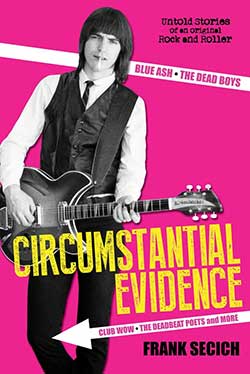 Not That Way Anymore
By Frank Secich
(High Voltage Publishing)
Circumstantial Evidence
By Frank Secich
(High Voltage Publishing)
So my good friends, I'm having some medical problems that are slowing down my productivity in every area of my life; I don’t get around much like I used to. So sorry I'm late, all my brothers and sisters and friends of the Revolution, but here in the shadows of balls-out, flock camera, no-due-process concentration camps, evisceration of the Fourth Amendment, torture gulags where underage immigrant girls are being impregnated by the homegrown masked Gestapo, tech Fascism and WW 3 - and pretty much everything Lords Of The New Church and The Wanderers spent all their most vital life force trying to warn us about, so it could all be avoided - is coming to life all around us.
- Details
- By Edwin Garland
- Hits: 907
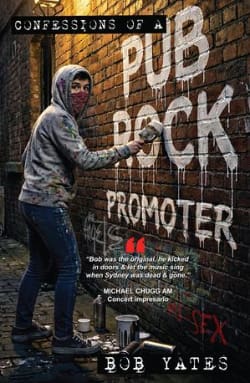 Confessions of a Pub Rock Promoter
By Bob Yates
Peach Tree Press
Not every half-baked musician, rock manager, pseudo academic or person who has dipped their toe into the entertainment industry can write a music book. The output often makes good doorstops. Music writing is an art of its own. Not everyone can write a song, either, but that’s another story.
That said, we do have some great writers in this country with an ability to capture a vibe. The best have a vibrancy to their work and an ability to translate exciting moments.
Some memoirs make an emotional connection or show a deep understanding of a moment in time. Overseas, Suzi Rotolo’s book on the early NY folk scene and her relationship with Bob Dylan springs to mind. Locally, the darkly cynical work of Bob Short and his musical journey, or Jim Moginie’s autobiography, are examples.
When an author is able to combine all of the above, you have gold.
Bob Yates manages this, both with his candid story of his deep love and regret about the loss of his dutiful and talented partner Virginia, and his journeys through the Australian music industry.
The book opens with a vista of the the beige world of Australia in the 1950s and ‘60s. A world of Menzies, portraits of Queen Elizabeth, and blokes who wore long socks and shorts. Like many kids, Bob’s world changed suddenly with the arrival of The Beatles, the Rolling Stones and Dylan and then war in Vietnam.
Bob and Virginia were a young couple building a home and a life together. Bob’s story about the loss of his marriage while deeply involved in music carries a sense of regret and ultimately humility.
Sydney kid Bob Yates had already proven to have that entrepreneurial spirit; the local paper boy who mowed lawns for a few shillings with his sleeves rolled up. In his teens, he was playing the stock market and made heaps of money - enough to pay half the deposit for house in Balmain. He then lost a small fortune and was in heavily in debt.
The character of a hard-edged promoter was shaped at early age, along with an ability to climb out of a hole. Bob was back waking up at 5am to start work again, putting in enormous hours in factory work, mowing lawns or as a cleaner.
Yates fell into the world of booking, and promoting gigs from his early 20s. It was completely street level, handing out flyers, doing poster runs and hiring halls. He held packed events at Balmain and Paddington Town Halls, as well as in assorted community and church halls, and some of his gigs drew almost a thousand people.
Bob’s book provides insights of a scene that I knew little about. In the late ‘60s and early ‘70s, Balmain was a hub of Sydney culture. “Confessions of a Rock Promoter” shines a light on acts like Jeannie Lewis and Captain Matchbox as well as the lesser known ones - including Ward and Johnston, the duothat Bob managed, That he ended getting major international supports for them like Ike and Tina Turner provides an understanding of the wheeling and dealing involved. Bob Yates was certainly a mover and shaker for close to a decade.
It was towards the end 1976 that Bob sensed a change in Australia. The impact of Radio Birdman on Sydney has been well documented. It was not only the music. Doors were now open to a variety of new music and new venues were springing up – especially iun their home town Sydney.
The legendary underground spot, French’s Tavern on Oxford Street, was changing its booking policy and opening a rock room downstairs. A band with a fervent following on the city’s northside had recently changed its name from FARM to Midnight Oil, and was dropping its prog rock pretentions with a nod to Radio Birdman’s twin guitar attack. Birdman’s impact was equally evident on The Angels who were evolving out of being a roots boogie band from Adelaide into something more theatrical and calculated.
Bob Yates’ story of Midnight Oil auditioning for the Stage Door Tavern where he was now the booker is hilarious – especially with the arrival of the fast talking and intense Garry Morris as their manager. Bob booked the Civic Hotel in Goulburn Street and by 1978 it was a bastion of a new breed of bands, hosting the art students from Mental as Anything and early gigs by The Angels and Cold Chisel.
It was here that the early postpunk scene emerged into the light and it was full houses most nights. You can feel the energy of that time in Bob’s writing. Rooms like The Civic gave a home to arty indie bands and allowed them to be creative. Punk venues were also opening in the rundown parts of the city near Central Station and were drawing mostly underage kids. It was, as Yates relates, a real changing of the guard.
The book explodes as Ian Rilen makes his entry into its pages. Bob Yates perfectly captures the man’s spirit and charisma – the wildness and raw talent.
Ian’s formation of X had really made an impact on Sydney. A tough, street level bass player with a grounding in bands like Fraternity, Band of Light and the early Rose Tattoo, Ian left that latter band with “Bad Boy for Love” before departing because he thought they were heading in the wrong direction. Now he had a new beast.
Unlike Midnight Oil, who were allocated a Tuesday audition, Bob gave X their first Civic gig on a Friday night on reputation alone - and for a huge guarantee. The line-up down Pitt Street was full of a new breed of inner-city audience with a red “X” painted or stencilled onto ripped jeans and tee-shirts. X drew a full house, leaving scars on the carpet and broken glasses as far as the eye could see. Yet they were welcome back as they broke the bar record.
A couple of years later, Ian wanted Bob to manage his stunning new band Sardine V. Yates, had a fair a bit to do with Ian securing a publishing deal. Ian was certainly one of the most talented songwriters to have emerged on the scene.
Bob’s description of the inner-city music scene of punk and post punk is raw and exciting. Yates was well over a decade older than most of the musicians on stage and even older than an audience mostly aged in their teens. His background was a decade in folk music and roots bands. He describes the sudden shift as a massive tidal wave with words conveying the rawness and passion of the music itself. These bands he cites are names many of us know; Laughing Clowns, Lipstick Killers, Hitman, Ward 13, The Passengers, Jimmy and Boys, Flowers and The Professors among them, just to name a few.
Bob was now booker and promoter of The Civic, Stage Door and the Royal Antler on the Northern Beaches that was the Oils were packing out. A pivotal point for Bob was the arrival in 1978 of Mi-Sex from New Zealand, following a well-worn path trod by Dragon and the La De Das. Suddenly, they were the new band to check out. Yates was impressed.
A large section of book is focused on him taking them from a midweek, $50 a gig support band to being the biggest pop drawcard in Australia. It is tale of a gigantic rise to the top, built on belief, bravado and bold, sharp managements skills by a man who became workaholic. Sweeping up all the awards of 1980 and dealing with the American arm of CBS Records, the small-time Sydney promoter of a few years earlier found himself working with the biggest names in the industry and walking into the boardroom of a record monolith in New York City.
These are heartbreaking aspects to this. CBS were dickheads and it’s a body-blow to Bob when they don’t keep their word. There is a lot of fast talking. And the next thing can be another conversation and another line of coke. It’s a fascinating story and a warning to those who romanticised the industry without saying what really goes down.
Sadly, in world of inflated egos is a lack of understanding that what goes up can fall very quickly. Bob realises this is not his world and decides he wants out. He seen enough of where he does not want to be.
Bob’s final major foray into the big time was a Tiny Tim show, presented with artist Martin Sharpe at The Sydney Opera House. It’s a tale set in the twilight zone where art and street level promotion were never meant to meet.
Here we are in 2026 and the industry is completely changed and has lost its sense of alternative, counterculture. Private colleges have diplomas in music management and it’s a world away from the tough side of dealing with underworld figures with pistols in backroom offices drawers, bundles of cash in car boots, and amphetamine-fuelled roadies driving 3000 kilometres to get a band’s gear to a gig on time. A world with no Instagram, Facebook or band websites.
“Confessions of a Pub Rock Promoter” is a rip-roaring read by a gifted writer and a window into a time many decades ago.

- Details
- By The Barman
- Hits: 951
 Spirits Of The Hoey. A Love Letter To The Hopetoun Hotel
By Liz Giuffre and Gregory Ferris
Images by Bryan Cook
Melbourne Books
By The Barman
Love letters aren’t meant to be literary works; they’re words from the heart. That’s as apt as any descriptor for “Spirits Of The Hoey”, a 208-page softcover ode to a Sydney pub that closed its doors 16 years ago.
Every city should have a Hoey. Back in the ‘80s and ‘90s, Sydney had a few of them. I was always more of an Excelsior person, but The Hoey had something that it and other pubs lacked (maybe with the eventual exception of The Sando at Newtown) and that was a clientele that regarded it as a second home.
Back then, cheap rents and plentiful run-down inner-city housing meant the Sydney underground musical scene’s nexus was a handful of postcodes spanning Darlinghurst, Surry Hills and maybe Paddington.
You could have thrown a blanket over them (preferably black - as someone sonce said, it wasn't a colour but a way of life.) The Hoey was “the local” for many musicians in the scene. It may not have been Ground Zero for the city's underground rock but you could see it from there.
- Details
- By Robert Brokenmouth
- Hits: 901
 ARTVO1D
By Jeremy Gluck
(Lulu)
Ah, marvellous. Just what the world needed in its hour (well, decade, really) of self-inflicted demagogues, disgusting abuse of power, torture, wars-that-aren't-apparently-wars-though-that's-not-what-the-poor-bastards-beneath-the-bombs-think, and misery: a six-track EP of new songs by those finger-wagging irrelevancies, U2. Boys? Guys? Your time is OVER. Back to the 1980s with you!
Not naming any names, but it's a pity more bands formed in the late ‘70s couldn't break up a few decades earlier, perhaps with the lead singer going on to, I don't know, open a bongo shop, somewhere where he wouldn't be recognised. Perhaps ... Bear Island?
Right, well then, if we can just shove through the throng of lemmings-like U2 fans heading for the cliff, I'd like to remind you that the apparently endlessly prolific Jeremy Gluck once fronted The Barracudas, is the last man standing from the “I Knew Buffalo Bill” supergroup LP, and he's got a new art/picture book out: "ArtV01d".
- Details
- By The Barman
- Hits: 1905
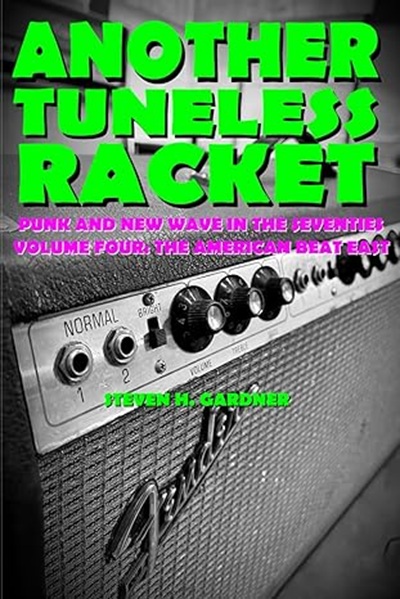 All Another Tuneless Racket. Punk and New Wave In the Seventies Volume Four: The American Beat East
By Stven M Gardner
(Noise For Heroes)
The intention was to read this cover-to-cover before penning a review, but time got the upper hand. As it does. You need to know about it before the onset of the Festive Season proper so you can put it on your Xmas shopping/wish list.
I’ve been dipping into and out of this “Another Tuneless Racket 4” over the past three months. It’s a punk rock “War and Peace” at nearly 690 pages but not a hard slog. It’s neatly compartmented into various regional musical scenes, so “ATR Volume Four” is ideal fodder, if your attention span is short or you want to dip in and out.
Notwithstanding it weighs a lot more than a mobile phone, you might find it essential Toilet Reading (or “Bathroom Reading” for sensitive Americans who think a bathing facility is co-located with what we Australians call The Dunny.)
Reading on the loo is probably a Bloke Thing but certainly not exclusively the domain of men or Australians. The bog is one place most people know they won’t be disturbed.
There’s a bonus if you’re getting on a bit and are not, er, as regular as you used to be, in that you can spend a long time combing these pages. The hefty size of “ATR4” (it’s nearly as heavy as one of those extinct things called phone books) means that if you lift your copy past shouilder height a few times, you can skip the gym.
There’s a lot to be said for Toilet Books. A good one takes your mind off the government bowel testing kit that arrived in the mail and is sitting on your sink, unopened. If you’re a Westerner visiting Japan, reading is less taxing than working out what all those controls on the side of the cistern do.
Unlike Jinglish instructions or medical self-diagnostics, however, “ATR” is a labour of love that comes from Steve Gardcner, the same rock and roll obsessive who spawned the American zine “Noise For Heroes” in the 1990s, and the record label of the same name.
- Details
- By The Barman
- Hits: 8085
 Headonism
By Peter Head with MJ Cornwall
(BookPOD)
The history of Australian rock and roll is chockablock with yarns about people who had their shot at The Big Prize. Adelaide-born Peter Head (nee Beagley) gave it a better shake than most, rising to prominence as pianist for prog rockers Headband, touring his bum off and playing in a pre-AC/DC band with some bloke named Bon Scott.
This is a man who rubbed shoulders with everyone from Elton John to John Mayall, John Farnham to the Rolling Stones. Adelaide-raised, Head did what a lot of Aussies did in the‘60s and followed his nose to work as a muso in England...only to suffer the same fate as many, if not most, of his peers and have it rubbed in Pommy squalor.
In the ‘80s Head transplanted himself to Sydney and became a fixture in the piano bars of Kings Cross. It was probably a natural progression for a bloke who kicked off his career as a 13-year-old backing bump-and-grind dancers in seedy Hindley Street bars. Along the way, he directed stage shows, toured nationally with the likes of Robyn Archer, carved out a regular place on the bill of the Adelaide Festival, filled in as backing pianist for “Here’s Humphrey”.
- Details
- By Robert Brokenmouth
- Hits: 8168
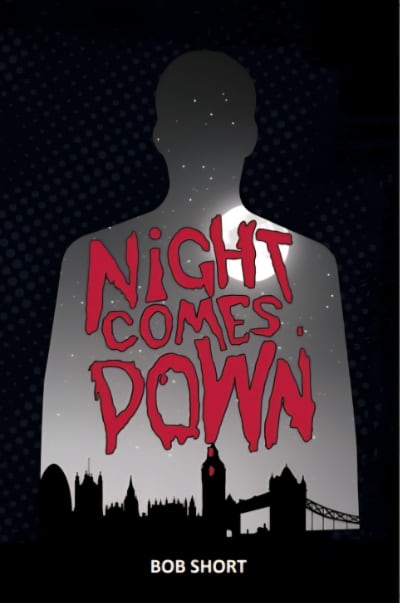 Night Comes Down
By Bob Short
(Earth Island Books)
Who could trust time when reason was lost?
I got pretty lucky. I did all the dumb things and I'm still here.
First, it's such a delight to read that I've snorked coffee over it several times in my usual cafe, as well as other unpleasant substances on the bus. So, if it's a horror story, it's one where you spray coffee over it, your table, pants and some lady's nice white frock.
Perhaps you could instead think of “Night Comes Down” as an amusing memoir with layers of horror? No, that won't work, there's just too much real horror.
Even the unreal can still feel like it is real. That hunk of meat in our heads is a totally unreliable narrator. We make excuses for things and pretend things never happened and yet weirdness is always nipping at our heels. Is anything true?
Perhaps you'll read it and think it's all made up. Strangely enough, Bob Short is (as usual) one step ahead of us.
- Details
- By The Barman
- Hits: 7560
 Craic As It Happened
By John Foy
(Past Present Future/Skull Printworks)
Tis the season for confessional show-and-tell Australian music books. Journalist Stuart Coupe had a shot with the entertaining “Shake Some Action”, and then underground label head-turned- mainstream industry publishing chief, Roger Grierson, gave us the rollicking “Lowbrow”. Now it’s John Foy’s turn.
Foy spent many years as a behind-the-scenes operative in the febrile underbelly of the Australian underground music scene. He kicked off in retail, made a mark as a poster designer and then became the driving force behind the Redeye and Blackeye record labels.
Like his mate Roger Grierson, he’s never been a household name, but if you bought or heard a record by Beasts of Bourbon, The Clouds, Deniz Tek, The Crystal Set, The Cruel Sea, Kim Salmon and The Surrealists and even Radio Birdman in the mid ‘80s or early ‘90s, you entered his orbit. Redeye gave the bands wide distribution via a hook-up with the multi-national Polygram/Phonogram major label operation.
Send us stuff to review
PO Box 334
Oatley NSW
2223 Australia
Get in touch: barman@i94bar.com
The Living Eye
I-94 Bar presents
Chris Masuak’s Dog Soldier
“The Shiny Side Tour”
OCT
8 - La La La’s, Wollongong, NSW
+ The Sugar Beats
+ Buzz Wagon
Tickets
9 - Smith’s Alternative, Canberra, ACT
+ ZZG
Tickets
10 - Shotkickers, Thornbury, VIC
+ Grindhouse
+ The Girlies
Tickets
11 - Trash Cult, Bendigo, VIC
+ Trip Hazard
(matinee)
Tickets
15 - Hamilton Station Hotel, Newcastle, NSW
+ SPLODGE
(free)
16 - Federal Hotel, Bellingen, NSW
+ Love City Radio
(free)
17 - The Cave Inn, Brisbane, QLD
+ Mick Medew & The Ursula 4
+ The Spivs
Tickets
18 - Vinnies Dive, Southport, Gold Coast, QLD
+ Mick Medew & The Ursula 4
+ The Spivs
Tickets
23 - Link & Pin, Woy Woy, NSW
+ The Dunhill Blues
Tickets
24 - Marrickville Bowlo, Marrickville, NSW
+ Fuck The Neighbours
+ The Stallers
Tickets
Negative Approach (US)
Australian Tour
OCT
21 - Lynott’s Lounge, Perth, WA
22 - Ed Castle, Adelaide, SA
23 - The Tote, Melbourne, VIC
24 - Singing Bird Studios, Frankston, VIC
29 - The Baso, Canberra, ACT
30 - La La La’s, Wollongong, NSW
31 - The Chippo, Sydney, NSW
NOV
6 - Vinnies Dive Bar, Southport, QLD
7 - The Brightside, Brisbane, QLD
8 - Black Box Theatre, Nambour, QLD
Tickets
Troy Tempest
Ace Traffic Reporter
presents
"Apocalypse Mayhem 2026"
The Dark Clouds
+ Slack Punks
+ Van Ruin
+ Kung Fu Grip
+ DISGRACELand
MoshPit, St Peters, NSW
- Oct 23
Tickets
Shonen Knife (Japan)
“Re-cuttin’ Australia/NZ 2026”
OCT
14 - The Tote, Melbourne, VIC
+ Moler
15 - Volta, Ballarat, VIC
+ Moler
16 - Sooki Bar, Belgrave, VIC
+ Moler
17 - Croxton Block Party, Melbourne, VIC
18 - Altar, Hobart, TAS
21 - Milk Bar, Perth, WA
+ Turnstyle
22 - The Gov, Adelaide, SA
+ Moler
24 - ZED51
Roma Street Parkland, Brisbane, QLD
w/ Mudhoney
+ Custard + The Mark Of Cain
+ Cash Savage & The Last Drinks
+ Tape/Off
25 - Alice Springs Brewing Co,
Alice Springs, NT
28 - The Baso, Canberra, ACT
+ Turnstyle + Media Puzzle
29 - Crowbar, Sydney, NSW
+ Turnstyle + Media Puzzle
30 - Keystone 1889, Bathurst, NSW
+ Turnstyle + Media Puzzle
31 - Avalon RSL, Avalon Beach, NSW
+ Turnstyle + Media Puzzle
NOV
1 - King Street, Newcastle, NSW
+ Turnstyle + Media Puzzle + Nursery Crimes
24 - Trash Cult, Eaglehawk, VIC
7 – 8 Tidal Sounds Music Festival
w/ Hard-Ons, Bodyjar, The Porkers,
Youth Group, The Grogans + Peach Fur and more
Hoey Moey, Coffs Harbour, NSW
New Christs
NOV
21 - The Brightside, Brisbane, QLD
+ Suicide Country Hour
+ Mick Medew & The Ursula 4
The Bawdies (JP)
“This Is The Party” Australian Tour
6 - Factory Floor, Sydney, NSW
+ PocketWatch + Jupiter 5
7 - River Rocks 2026, Geelong, VIC
8 - Bergy Bandroom, Brunswick, VIC
Tickets
Joeys Coop
NOV
28 - Blah Bar, Lismore, NSW
29 - Junk Bar, Brisbane, QLD (arvo)
The Cribs (UK)
"Selling A Vibe" Australian Tour
OCT
4 - 170 Russell, Melbourne, VIC
5 - Factory Theatre, Sydney, NSW
6 - The Triffid, Brisbane, QLD
8 - Rosemount Hotel, Perth, WA
Mudhoney
Australia-NZ 2026
OCT
16 - The Thornbury Theatre, Melbourne VIC
17 - Torquay Hotel, Torquay VIC
18 - Theatre Royal, Castlemaine VIC
20 - Volta, Ballarat VIC
21- Felons Barrel Room, Manly NSW
22 - Factory Theatre, Sydney NSW
23 - King Street, Newcastle NSW
24 - ZED 51, Brisbane QLD
25 - The Northern, Byron Bay NSW
28 - Blue Smoke, Christchurch NZ
29 - Meow, Wellington NZ
30 - Totara St, Tauranga NZ -
31 - Harbour Hotel, Raglan NZ
NOV
1 - Double Whammy, Auckland NZ
The Exploding Universe of Ed Kuepper
Ed Kuepper 50 Years Retrospective
RESCHEDULED
OCT
29 - Avoca Theatre, NSW
30 - Canberra, The Street Theatre, ACT
31 - Wombarra Bowlo, NSW
NOV
4 - Adelaide, The Gov, SA
5 - Melbourne, National Theatre, VIC
6 – Geelong, Barwon Heads Hotel, VIC
7 - Sydney, Factory Theatre, NSW
(matinee & evening shows)
13 - Fremantle, Freo Social, WA
15 - Brisbane, Princess Theatre, QLD
Tickets
Reverend Horton Heat (US)
Australian Tour
NOV
11 - Crowbar, Brisbane, QLD
+ The Linelockers
+ Jake & The Cadillacs
+ DJ Lori Lee
12 - The Gov, Adelaide, SA
+ The Satellites
13 - Factory Theatre, Sydney, NSW
+ The Johnnys
+ Pat Capocci
14 - Croxton Bandroom, Melbourne, VIC
+ The Johnnys
+ Ezra Lee & Jumpin' Jethro
15 - Theatre Royal, Castlemaine, VIC
+ The Johnnys
Hoodoo Gurus
"Rewind Tour - All Killer, No Filler"
+ Ratcat
+ The Stems
NOV
28 - Hindley Street Music Hall, Adelaide, SA
DEC
1 - Ice Cream Factory, Perth, WA
5 - Tumbalong Park, Sydney, NSW
6 - Royal Botanic Gardens, Melbourne, VIC
11 - Fortitude Music Hall, Brisbane, QLD
16 - Odeon Theatre, Hobart, TAS
The Saints 73-78
UK Tour with The Damned
NOV
25 - Brighton, Dome
27 - London, British Airways ARC
28 - Bristol, Beacon
30 - Manchester, Academy
DEC
1 - Newcastle, O2 City Hall
2 - Derby, Vaillant Live Derby
5 - Birmingham, O2 Academy
The Saints 73-78
Australian Tour
JAN
21 - Newcastle, King St
+ Chimers
22 - Sydney, Metro
+ Antenna
23 - Wollongong, Waves
+ The New Christs
29 - Brisbane, Tivoli
+ Tape / Off
30 - Gold Coast, Miami Marketta
+ Mick Medew & The Ursula 4
FEB
2 - Perth, Astor
+ Last Quokka
4 - Barwon Heads, Barwon Heads Hotel
+ dB4
5 - Melbourne, Croxton
+ Public Figures
Public Image Ltd
Australia and NZ
JAN
20 - Auckland, Powerstation
22 - Brisbane, The Tivoli
23 - Sydney, Enmore Theatre
24 - Melbourne, The Forum
26 – Adelaide, The Gov
28 - Perth, The Astor
"Superpussy 2"
The Supersuckers
+ Nashville Pussy
+ Nine Pound Hammer
FEB 2027
18 - Crowbar, Brisbane, QLD
19 - Mo's Desert Clubhouse, Gold Coast, QLD
20 - Crowbar, Sydney, NSW
24 - Ed Castle, Adelaide, SA
26 - Barwon Club, Geelong, VIC
27 - Croxton Bandroom, Melbourne, VIC
28 - Young Street Tavern, Frankston, VIC
Respect The Rock Australian Tour
The Hellacopters + Gluecifier
MARCH
17 – Brisbane, The Triffid
18 – Sydney, Manning Bar
19 – Melbourne, The Croxton
20 – Adelaide, Ed Castle
Tickets
Fresh Reviews
-
Kennedy's Collaborations bear fruit
04 October 2026
-
Easy Action delivers another Stooges hit job
29 September 2026
-
The prank's on Mark E. Smith (but he's having the last posthumous laugh)
28 September 2026
-
It's not too late to take a chance on Perth's Volcanics
20 September 2026
-
This man needs to be Instutionalised
19 September 2026