 (Pondering the passing of time, punk, and the “new” Young Charlatans record, “'1978”, released on Eminent Vinyl, and featuring a short interview with Harry Howard.)
UK writer Kris Needs expresses it best, I think. In his introduction to his 2010 “Dirty Water 2. More Birth of Punk Attitude” CD compilation, Needs denies trying to nail down "any kind of definitive punk thesis", and instead tries "to show how the age-old attitude which shaped it could not be confined to any one time, place or big bang”.
He goes on to describe punk as "an eternal spirit", explaining that the "desire to achieve or express personal freedom is one major uniting theme, whether an attitude born out of everyday struggle or desire to upend existing musical forms, which could spark in anyone from guitar-toting wild men and electronic alchemists to street corner finger-poppers or expressionistic black music movements such as bebop and free jazz."
Feel free to disagree, of course.
A couple of months ago, the ABC website put up an article by Ned Hammond with the headline: "Punk's boom began 50 years ago in Brisbane". Hammond is, of course, referring to The Saints' first (self-made) single in 1976. Which wasn't “punk'” because punk as a widespread music genre didn't exist, and punk as a musical genre has so many origin stories it's as bad as trying to sort out the missing link. Also, The Saints didn't think they were punk.
Forgive the old man shouting at cloud moment, but headlines like this are misinformation at best - and while I would like to say that the ABC should know better, all us old farts know that the ABC hasn't known any better for over 25 years. AI is just the dementia on the cake.
The ABC is hardly alone in trying to pull straws together which should never be put together because while they might seem similar, they ain't necessarily linked, and to claim they are is, you know, factually incorrect. Wikipedia pages abound as webjockeys attempt to link a complicated structure of timelines and pigeonholes, as if all the events and bands are all linked and part of the same dreary enclosure - when they weren't; the only real link was that there was a series of scenes and a bunch of bands and art and books all leading to a huge, heaving, exciting groundswell - and these people were part of it.
I'll just repeat that zinger from Needs: "the age-old attitude which shaped [punk] could not be confined to any one time, place or big bang”.
Now then. Let's put on our old man straw hat, pull on our Tommy Pilfinger polo shirt, our big ol' board shorts and Crocs, and do what we old farts do so very, very well: let us sally forth to the past, where before punk, there was not “proto-punk'” nor hundreds of subgenres ... and where almost every band was ... just a sort of rock band.
Some, of course, were damned strange, but that's human nature for you.
Back in Australia, I was 12 and just discovering real modern music, avidly reading everything I could and listening to everything my chum Paul Slater bought and slapped with triumph onto the turntable. Sure, I remember that “(I'm) Stranded” had a seismic impact all around the country - and to some extent overseas.
And everybody knows (except the ABC headline writers) that The Saints never thought of themselves as a punk band - not when they started, nor when they arrived and played in London. Certainly their music fitted into the era, but ... there were a raft of bands who felt the same imperative, from The Ramones to Blondie, Devo and Pere Ubu, to The Sex Pistols, The Stranglers and Ultravox!, to Radio Birdman, The Saints and ... Young Charlatans.
Let's clarify this just a bit. Lachlan Kanoniuk's article "The Birth of Melbourne Punk" (on the Red Bull site - go figure) features the slugline quote (from Quincey McLean): "No-one ever called themselves punk."
Well, yeah. Exactly. Kanoniuk quotes Birthday Party/Psychedelic Furs drummer Phill Calvert: "We never called ourselves punk. We didn’t want to be part of the mainstream, we wanted to be part of the new."
In the same article, Bruce Milne cites seven bands who "defined the birth of punk in Melbourne" - one of those is Young Charlatans, who were unable to produce a record at the time. On his website, Clinton Walker describes them as "a definitive post-punk outfit who showed how rock could re-start after punk had wiped the slate clean".
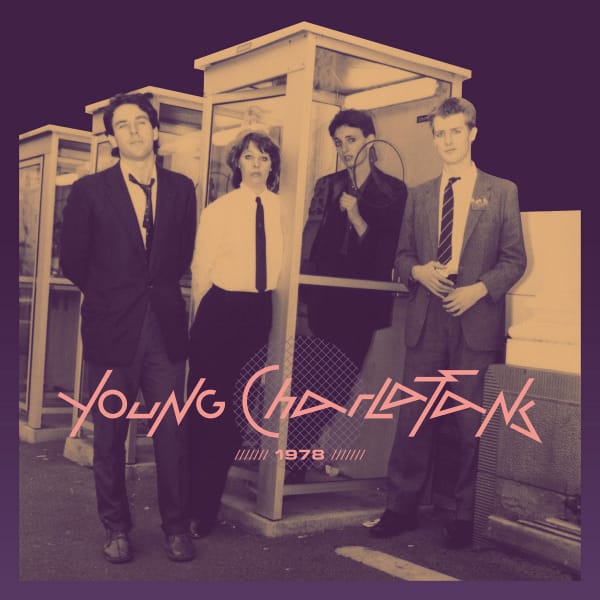
“1978” (titled that way because that's when these songs were recorded) is Young Charlatans' first record. Have you read Ed Garland's recent impassioned review? His use of terms like "blistering", "urgent", "wild", "intensity", "blazing", "aggressive", "startling" and "brutal" is spot-on.
But - and it's a big “but” - you can hear a lot more in there. In particular, there are quieter songs which are equally as powerful, including Rowland's (now actually-iconic) “Shivers” which, when released as a single by The Boys Next Door, remained in print (as in available new from the record company) until the end of vinyl in the 1990s.
Much may be made of the sound quality of these recordings, but to that I can only respond: if you're fussing over that, you're missing the point in multiple cylinders. For decades, especially during the 1980s and ‘90s, Young Charlatans were a legendary, mostly never-heard myth.
To hear them now is validation of a sort: Harry Howard saw them and commented that "it's a crying shame they were never recorded properly". He's right, but we're damned fortunate to have this record which reveals a damned exciting band full of piss, vinegar, smarts, intelligence and hectic influences from Rimbaud and Verlaine to Lou Reed, Iggy Pop and Ed Kuepper.
As you may know, recently I did an interview with Peter Black of the Hard-Ons. The lads have been around for a darn long time, and while some might say they might fit tidily into the 'punk-pop' in-tray, the breadth of Black's solo LPs is far removed from that basket - yet of course these extraordinary songs don't get as much traction as the familiar 'known quantity' of the Hard-Ons.
In the interview, I asked Blackie about an old quote of his (from many years ago) about wanting to be a punk rocker; in part, he replied, "I don't even care about being a punk rocker. I just wanna make good music".
Here's Hugh Cornwell, from his 2004 “Multitude of Sins” autobiography (Harper Collins): "We'd been happy to be called a punk band, as it gave us an opportunity to attract press and secure a record contract, but it didn't seem to describe our style of music properly."
I'll buy those for a dollar! And that's what we have here, brothers and sisters...
Young Charlatans were not, as Wikipedia says, "a briefly existing punk rock band", but a band very much created by the musicians being in a specific time and place. Many of the bands in Melbourne's swelling alternative scene heeded punk's clarion call to “form your own band” and “be different”. They weren't embracing what punk had become by 1977 in the UK, but were utilising the notoriety of punk as a springboard.
Today is nothing like the world yesterday, and people's behaviour cannot fully be judged on today's standards or expectations; record companies existed, were actually accessible (in the sense that you could walk into their office and speak to real human beings). And, they were always keen to hear new bands because they could make a shitload money off them.
And, when you're young you wouldn't mind making a lot of money and being a famous rock star. There's a determined projection of self ... and this lead to many recording contracts. The famous "suicide record", “Lethal Weapons”, featured songs by seven bands of the era - most notably perhaps, The Boys Next Door (before Rowland S. Howard joined, and long before Nick Cave was a star), with future members of Models and The Sacred Cowboys.
A point to remember is that then-Premier Artists booking agent Barrie Earl went out into the pubs looking for appropriate bands to record - several, like Melbourne's News and Sydney's Filth, were revolted by the offer and refused. It is tempting to imagine Young Charlatans also refusing, but I personally suspect they weren't approached.
On the website “Punk Journey”, then-member of JAB, Ash Wednesday, recalls: “We went round for the pre-signing talk at Barrie’s apartment in South Yarra. There’s a white fluffy carpet, nice white fluffy lounge, a white afghan hound, and a nice human lady incarnation of the hound. Barry gave us a tacky initiation speech; it was all "hundreds of thousands, hundreds of thousands, money money money”; he behaved as if he was right in there at the pulse and he knew what was happening…”
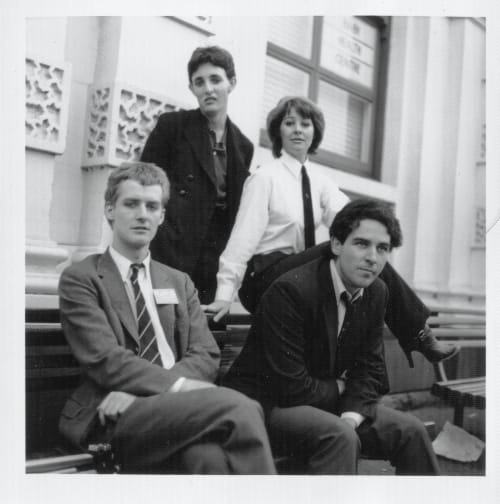
One person who was definitely'there at the time and who hasn't yet been asked about his impressions of Young Charlatans, is Harry Howard, the younger brother of Rowland S. Howard.
* * * * *
I-94 Bar: When people who were not of that generation look at the "punk" or "new wave" thing, what do they usually get wrong?
Harry Howard: Well, they might think it had nothing to do with what came before it, which isn't right. The initial Melbourne punk scene was quite arty, connected to elements of glam, and influenced by Bowie and Eno from Europe, and then The Stooges and Lou Reed from the States. But people very quickly caught on to this kind of buzzsaw-style of The Ramones or perhaps The Saints, and though I'd hate to be caught describing Ed Kuepper's guitar style as "buzzsaw" it did have a pretty ferocious and distorted rhythm style. "New Rose" by The Damned was also one of the first "punk" singles. Short sharp songs were all the rage.
I-94 Bar: What's the difference between the myth we all seem to accept, and the reality as it was ..?
Harry Howard: I don't know, Robert, to be honest. But was a really, really vibrant scene that was determinedly independent, which really wanted to differentiate itself very clearly from mainstream rock music. A lot of music in the 1960s was quite “punky” but there was a lot of very dreary music masquerading as “rock” in the 1970s giving the brand a bad name.
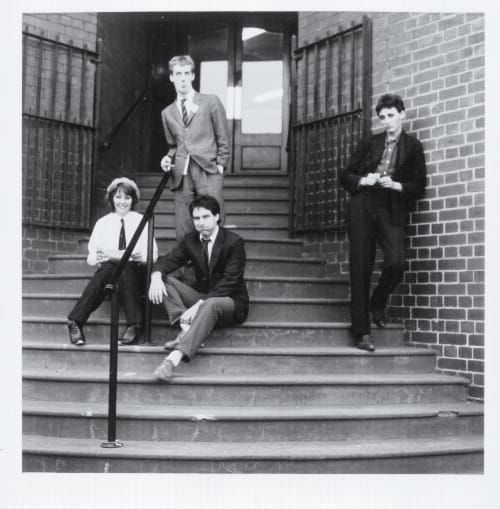 Philip Morland photo. Supplied.
I-94 Bar: What were those initial punk gigs like - did you all know each other already or were you all discovering each other?
Harry Howard: I was so young, I didn't know anyone. I was going with friends. I met people of course, but I would go to The Tiger Lounge to see The Boys Next Door or wherever it was that the Young Charlatans played (Bernhardt's?) or shows at Universities where Sports might headline and a bunch of the punkier bands play in support.
I-94 Bar: You had an older brother who was striking, and adventurous, and who became deeply involved - and ambitious - in this underworld. How did you react, and ... how do you remember his steps forward?
Harry Howard: Rowland was very confident outwardly. He had already cultivated a personality that was quite original, it wasn't based on boring Australian cultural cliches at all. He was witty and erudite and he was educated; well, he was self-educated. He spoke with an educated voice. He also went through a lot of heartache, so as bright as he might seem he could also come home with self-inflicted cigarette burns on his forearm. Really quite deep burns.
He was a tricky older brother. "Older", of course, meaning he was in a position of power when it came to me, and let's say he played with that quite a lot - undoubtedly I would've been incredibly annoying and probably deserved at least half of it.
I-94 Bar: Did he play you any of his early songs before working with other people?
Harry Howard: No, he never did. You'd find lyrics in the lounge room etc. Boldly writ with black spidery Rotring pens that he also used to stab warts on back of his hand, injecting them with what he thought was poisonous ink, he hoped.
I-94 Bar: What was it like seeing him play - was there a shared intimacy, for example?
Harry Howard: No, it just seemed natural really. I just liked what he did.
Philip Morland photo. Supplied.
I-94 Bar: What were (his earlier band) Tootho and the Ring of Confidence like? How were they received?
Harry Howard: I did see the end of a show once; I think Rowland was playing saxophone in a song. My father and I had driven there to pick him up. Our father did a hell of a lot of taxi-ing. I think they were just an arty young group of their time but I don't have any specific memories to offer, sorry.
I-94 Bar: Tell me everything you can remember about the Young Charlatans!
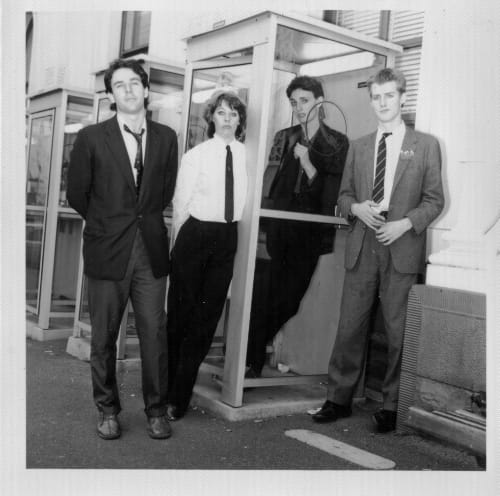
Harry Howard: No!...They were the best band in Melbourne at the time. Ollie and Rowland both wrote these great songs, each as amazing as each other. It's really quite remarkable that they were so good.
I-94 Bar: What was the mixture of personalities like? everyone was so young, and so determined to shine. Did they tread on each other?
Harry Howard: They had more than their share of tension. Rowland was initially romantically involved with Janine who was the most easy-going. Jeffery was very volatile, he hurled a hi-hat pedal at my head once because I touched his drums. Those things are heavy! Ollie was complicated and possibly unreasonable at times. They were all very intelligent and had complex personalities.
I-94 Bar: Assuming you've had a chance to listen to the Eminent Vinyl release of the Young Charlatans demos and live recording - is it how you remember seeing them - if not, what's different?
Harry Howard: Yes and no. You can't capture how inventive they were at that point in time - they had so many facets, it was intelligent music somehow. It was aggressive but it had art references in it, and it was done with panache. It can't really sound like something new fifty years after the fact - but it did then, it was fresh.
I-94 Bar: Young Charlatans are described as having a huge impact, but what exactly was that impact on the people who saw them - I mean, “the shock of the new”, or “I think I can do that”?
Harry Howard: They probably raised the bar for people who were interested.
 Philip Morland photo. Supplied.
I-94 Bar: Surely there were other bands which had similar impacts at the time - Crime and the City Solution for one, and the Boys Next Door, and the Negatives ... can you distinguish between them?
Harry Howard: Crime were later - but that first version of Crime was really mesmerising and more mysterious and exotic than anything I'd seen in the “punk” vein up until that point. The Boys Next Door were just really good, they were very confident and their live shows were always great. The Negatives were a pretty powerful band but to me they were slightly backward-looking and a bit murky.
I-94 Bar: Now, a bit of heresy. Surely this scene was so small it was essentially not as significant - in the broad sense - as it's represented today?
Harry Howard: Well no, culture starts small and goes large. It's still influencing things. Nick Cave is a product of the Melbourne punk scene. Michel Hutchence was totally enamoured by it. Rowland is still feverishly revered in the furtherest corners of the globe. Legend is important. There was a cultural revolution going on. What did Mick Harvey say, "we fought the good war", and that's the task of youth, isn't it?
I-94 Bar: Another bit of heresy. St Kilda seems incredibly ignorant of its position in the history of music - never mind just Australian music, by the way. Any idea why this is?
Harry Howard: I think the council know something of it - Nick Haines got them to do Rowland S. Howard Lane. That's recognition, I think.
I-94 Bar: Prior to 1980, which Melbourne bands really affected you?
Harry Howard: All the bands we've talked about, plus so many more, I could probably list 25 bands. Some would come and go, others would come and stay. I'm loathe to make a list because I'd leave things out accidentally.
I-94 Bar: We're talking about the world-wide impact of teenage musicians - is it fair to peer back and imagine all manner of possibilities? Is it fair to judge someone's life on the basis of what they did when they were so young?
Harry Howard: No, that's not fair. But it is fair to celebrate what people did when they were young. For whatever reason, young people seem to excel in expressing their times with music, 'rock music', 'punk' whatever you might like to call it.
And that youthful energy can deliver a kick that lasts.
I am getting paid for all this, aren't I, Robert? ... Robert?
I-94 Bar: I'll buy you a souvlaki. Or perhaps a laksa.
* * * * *
In closing, “1978” is as an essential Australian LP to own as “X-Aspirations”, “AlphaBravoCharlieEchoFoxtrotGolf”, “Hunters and Collectors”, “Radios Appear”, “(I'm) Stranded”, “Prayers On Fire”, “Trouble from Providence”, “Blood Red River”, “Mr Uddich-Schmuddich Goes to Town” (and a host of others I'm sure you're mentally adding right now).
Here's Clinton Walker (again from his website): "I remember once a little while back talking to an eminent Australian rock critic/ historian of my acquaintance and he said to me, "I think you’ve overrated the importance of the Young Charlatans". To which I replied, "Actually, I think I’ve underrated them""
Only having this record for guidance, I can only concur. Get it.
Oh, and a shout-out. Hugh Cornwell's touring with a full band next month. If you've not heard the man with his band - particularly with this tour's bassist, Steve “Trash” Fishman, go book yourself a slot here.