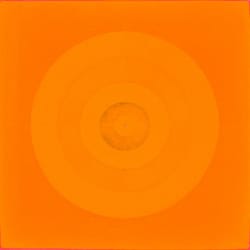
 ARTVO1D
By Jeremy Gluck
(Lulu)
Ah, marvellous. Just what the world needed in its hour (well, decade, really) of self-inflicted demagogues, disgusting abuse of power, torture, wars-that-aren't-apparently-wars-though-that's-not-what-the-poor-bastards-beneath-the-bombs-think, and misery: a six-track EP of new songs by those finger-wagging irrelevancies, U2. Boys? Guys? Your time is OVER. Back to the 1980s with you!
Not naming any names, but it's a pity more bands formed in the late ‘70s couldn't break up a few decades earlier, perhaps with the lead singer going on to, I don't know, open a bongo shop, somewhere where he wouldn't be recognised. Perhaps ... Bear Island?
Right, well then, if we can just shove through the throng of lemmings-like U2 fans heading for the cliff, I'd like to remind you that the apparently endlessly prolific Jeremy Gluck once fronted The Barracudas, is the last man standing from the “I Knew Buffalo Bill” supergroup LP, and he's got a new art/picture book out: "ArtV01d".
Jeremy Gluck's career is far more intriguing than any bleached and artificially distressed pop star. After fronting The Barracudas, instead of getting religion (or a horrible solo career featuring tantric sex and turtles), he got family and love, found himself in Swansea and realised - what was in him was coming out as art instead of songs.
Decades later people still talk about the apparent “Gluck Dichotomy”. But when one encounters art (and artists, including musicians and erm, vocalists), especially what is termed 'modern' art, you react how you react. Sure, one person's 'tosser!' is another person's 'sublime!', but quality always emerges.
A word of caution, however; the way to approach a book like “ArtV01d” is to dip into it, probably non-sequentially. Certainly, do not curl up with slippers, pipe and a bottle of Laphroag on dark and stormy night in expectation of an orderly tale derring-do, sword-fights, ripped bodices, mad monks, heaving and sweaty bodies, blood and passion followed by dissection, immolation and shame. This would be a grievous mistake (and would probably lead to you torching your prized art collection).
The blurb on the publisher's website quotes the book:
ArtV01d emerges as a rupture - an ontological glitch - where Nonceptualism and No-production converge to unmake meaning. It rejects the fetish of output and embraces lumpen conceptual mass. In this void, ideas cease to individuate; they cluster, decay, and implode. No-production becomes quantum creativity: the subtraction of one from zero, yielding not absence but saturated nullity.
Don't you love that phrase “ontological glitch”? I'm going to use it more frequently in conversation. And, "saturated nullity". Magnificent. The exquisite daftness of "unmaking meaning" and how the book "rejects the fetish of output and embraces lumpen conceptual mass". Oh, lord. Heavy topics from Mr Gluck ..?
No. Once you pick up “ARTVO1D'” you instantly get what Gluck is about. No, really.
See, from my perspective, Gluck's work is as much about self-discovery and illumination in the face of an untroubled, indifferent chaotic world as anyone else's. By attempting to reduce so much of life, Gluck reveals it in all its glorious magnificence; think of Constable's vast skies roiling above the ordinary trudge of everyday life beneath. Constable's beauty above allows us to realise then discover the natural beauty and simplicity of the everyday with great clarity. As far as I can tell, the best art allows us to reflect on our own experiences, our own perceptions, and discover new meaning and joy of life. (Rest in peace, film-maker Fred Wiseman.)
Mind if I give an example or two?
Now, every small burg is no exception to the pomposity of worthiness, in which deluded, self-important dingbats (think of the local council in your area) imagine that they are making a significant contribution to the interior life of the “vibrant” and “diverse” locals by erecting a vile sculpture or a bland, happy-bappy mural which no-one is interested in (least of all those it's supposed to encourage), and telling everyone how worthy the vile sculpture or pissweak mural is. All paid for by the hapless taxpayer, such public splats arranged by such deluded worthies are routinely ignored by all and sundry (except the pretentious or confused) as they hurry past (trying not to wince) on their way to and from work.
As a consequence there are innumerable ugly, bafflingly pointless, irritating sculptures in and around the city (Adelaide) where I live - but I'm sure you have a similar experience where you are, hmmm?
Granted, many artists are so wrapped up with assorted possible and potential meanings to their work that you cannot find yourself able to respond to the icky thing when you encounter it (except to ignore it). One of my favourite cartoonists, Carl Giles, frequently depicted artists as scruffy, bearded bohemians living in dripping garrets (with a bored and weary girlfriend) as they smashed their rejected squiggly canvases over a chair: each canvas titled, “The Message”.
There are always artists who insist on producing things which hector and lecture like a certain U2 singer, and generally behave as if the artist is at the right-hand of God almighty, with the tablets to prove it.
Many others study the Ziggurat and aim to be rich.
However. Some very few artists create something to which we can gleefully respond with warm affection and delight. Some very few artists create something which appears to inhabit the world of art, with all its pretensions, pointless pontifications and self-consecrated boho nonsense.
Two of my favourite sculptures in South Australia are in Rundle Mall and are usually referred to as “The Balls:, and “The Pigs”. It comes as a slight surprise that their correct titles are “The Spheres” by Bert Flugelman, and “A Day Out” by Marguerite Derricourt. I'm sure you're familiar with them.
I wonder how many of Adelaide's visitors have seen - nay, encountered - the sculpture near the corner of James Congdon Drive and Port Road? Its manufacturers Wilde and Woollard refer to it on their website as “Native Bee Memorial”, although the plaque beside it calls it “Flock Shelter” because it was "inspired by the intricate flight-paths of bees, mapped using harmonic radar technology". Skein artists James Martin and Steve Hooper designed "a shelter that responded to an industrial site reclamation masterplan".
This is so very Adelaide; "a shelter that responded", ffs. But also: "shelter"?! Mate, take a look at the picture. Unless you bring your own damned big tarp, this 'shelter' offers none whatsoever, yet manages to be a space, a place, and a definite structure for no apparent purpose whatsoever. Also, it's in that horrible rust style, which I have always loathed.
In fact, unless you look carefully as your car whizzes past the area, “Flock Shelter” is almost completely hidden amongst the foliage. You're only likely to see “Flock Shelter” if it's on your path to work from the western burbles, or if you use the useful oval nearby.
“Flock Shelter” is utterly marvellous; playful, serious yet light, loaded with the expression of lived experience. And people use it as a central point for gatherings, by day and night. It's also an ideal picnic spot, with a powered barbie and a useful power socket (there are many similar public picnic areas dotted around Adelaide), and it is one of Adelaide's great (albeit secret) delights.
Speaking of secret delights, let's talk about artist Jeremy Gluck's latest book.
Gluck often exhibits at the Tides fine art gallery in Swansea; the blurb on their website initially explains that Gluck "has exhibited in London, Sydney, Bath, and Swansea, is a member of Non-Place Collective based at Fringe Arts Bath, and is a co-founder of Swansea-based Axe Head Collective. A film created by him is now part of the BFI archive".
In fine Gluckian form it continues:
Gluck's art is "part of a growing body of postdigital work built, not born, of “no-production” (the artist’s neologism referring to the phenomenon of the action of unmaking or the process of being so unmade, that point at which the liminal collapses without hope of progression)", and that "Gluck’s current practice is an NFT interrogation incorporating live coding, glitch, writing, spoken word, and photography. With its soothing yet unsettling atmosphere, Gluck’s work responds to the world within, the non-place of the subconscious, and its diverse expressions."
How you doing there, alright? "Soothed yet unsettled"? And there's a 'Non-Place Collective'; can you imagine rolling up to the designated non-place for the monthly meeting? I wonder what their monthly subsidy is?
I mean, come on, it's brilliant, isn't it? Yes, artist statements or, worse, art gallery statements are sometimes so damned po-faced you're seized with a strong muscular urge to take the ivory-tower-living clods outside and chuck them headfirst into the real world where there's always a few chaotic individuals nearby struggling to find stability and identity - with often hideous repercussions.
So. As with “Flock Shelter'”(affectionately known as “The Ribcage” to the locals), some art you have to experience, because whatever baffling codes are being enacted by the artist or gallery, the reality is quite a different thing. The one exhibition I attended at Tides was of a number of artists, all quite unique, exciting and damned well-done.
Despite the fact that Swansea is a tad ‘burbian parochial, the work displayed in the gallery was world-class - and I've visited some world-class galleries which were and are far less interesting. From memory I think Gluck only had about three pieces on display, so the excellence of the other artists made perfect sense.
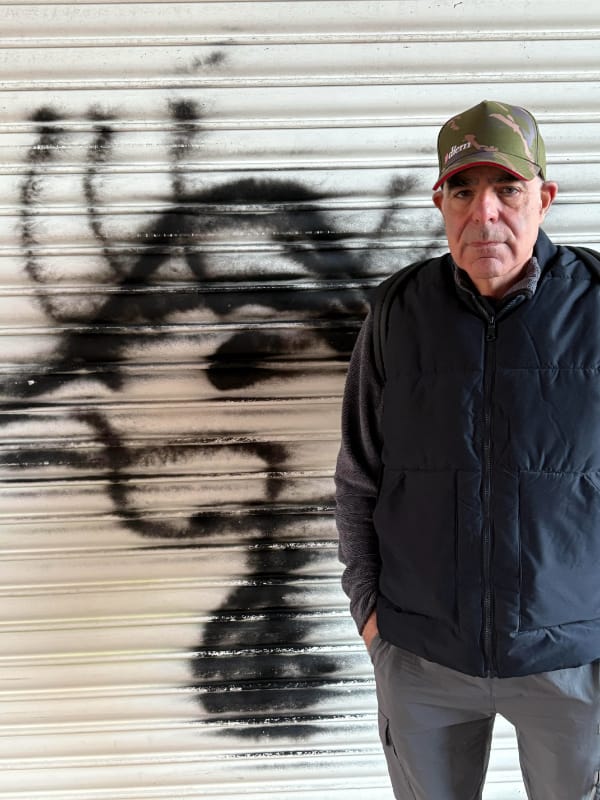 Jeremy Gluck. Robert Brokenmouth photo
So, alright, we don't usually think of a book as an artwork. However, "ARTVO1D" is a book somewhere between temptation and offspring, between something and nothing, between the concrete and the muse. If you like your art mentally and emotionally provocative (perhaps a bit like, in 1992, preferring to watch GG Allin on TV rather than having the bugger in for coffee and cake with the missus), then "ARTVO1D" is worthy of your attention.
“ARTVO1D” is the fifth of Gluck's books published by Lulu, and I guarantee you'll find the lot suitably diverting. Certainly more diverting and intriguing than (say) Jeffrey Archer or (say) Dr Randa Abdel-Fattah, both of which sound like a harsh punishment to me.
The first thing you notice when you open the book is that Gluck has deliberately and obviously used AI tools to produce a short manifesto-like work of art, which parodies (while asserting!) political and art manifestoes. One major thread is the revelation of the reality of AI (which is neither artificial nor intelligent, of course). While I'm sure other artists are looking at AI, we can be reasonably sure that no-one else is making statements about it in the same way Gluck does;
A I can be seen, i n a sense, as the manifestation o f a
decentralised nervous system the i m p l i ci t nature o f
which i s nothing l e s s than a p a r a l l e l form o f
consciousness to our own and the provenance o f which
w i l l become a techno-psychic cloud exos keleton.
In case you hadn't realised, (sic). Also, no, no AI was used in that construction...
The second thing you notice is that Gluck is fascinated by how data, information and sense rearranges itself, and how our realities and expectations differ from a machine's. What Gluck has manifestly not done is to create pretty or funny pictures by using specific prompts; his pictures are always simple, always balanced, always ... (are you ready?) "soothing but unnerving".
What Gluck has achieved is a swirling, contradictory internal debate on the self, art, meaning and life (via interrogating AI). It is gloriously not possible to know which is the pure Gluckian blend of paradoxes and opening dead ends, and which is the AI burbling away like a stream beneath an expertly-handled rudder.
"Unterzone: meaning collapses, production is refused, and art becomes a ritual of negation. “ A r t ≠ S i g n a l ”
If you see what he means. We can't help but search for the meaning, and while on the one hand such statements are quite clear, we are forced to ponder - but is it, really?
Which makes us feel a little self-conscious, a bit like when your dumb uncle is caught trying on a selection of tinfoil hats in the mirror.
Here's another example: "ArtV01d manifests through corrupted data, visual static, and deconstructed media, asserting that meaning can be found not in the presented image or object, but in its fragmentation, degradation, or deliberate non-existence. This sub-movement questions traditional notions of authorship, permanence, and the commodification of art by presenting works that are inherently ephemeral, unstable, or paradoxically defined by what they lack."
And, again, this makes perfect sense. Gluck has been exploring these themes within the concept of art for some years now, and "ARTVO1D" is a distillation, or further exploration. Interestingly, his fingerprints are all over it; when I cut and pasted the above quotation, I had to eliminate a lot of spaces between letters (see the quote further above) - presumably Gluck had been tinkering with the text and separating letters to create new sub-pathways.
"Gluck-tracks", perhaps, discovered by "Gluck-traces", are throughout, like little trails of breadcrumbs through the byways of Swansea. And yes, it is all about Gluck and the murmurs in his blood; like most creatives, he's hidden himself in plain sight. The book is by no means unintelligible (although it tries to be), and it is a massive poke and pike at the semiotic nerverats in the industrial art complex.
Oh, dear, now he's got me at it as well.
A little later, the picture 'The Unterzone Engin-e' captures the imagination. Described as "a cold schematic o f collapse — an anti-
machine diagrammed i n the language o f bureaucratic r u i n" (uh, sic...), one begins to marvel at Gluck's perverse imagination, but also we can hear his pixie-like giggling in the background. Never has challenging art and our expectations been so much fun. Some parts of the text read a bit like William Gibson: "The Engin-E i s i t s f a i l e d apparatus — part glyph, part g l i t c h , part typographic autopsy. I t does not f u n cti o n . I t performs dysfun ction."
I'm cracking up, its hysterically funny, hysterical, stupid, sensible, unsettling and yet ... after we've recovered ... there's a sort of calm of renewal (perhaps a bit like emerging from confession in a catholic church).
One of Gluck's (stated) influences is "Metzger". Now, while I know he means Gustav Metzger (1926-2017), who came up with the concept of "Auto-Destructive Art" and the 'Art Strike'; the casual reader might be thinking, 'hang on, what's stand-up comic Kurt Metzger got to do with this Non-ceptual thing? What joke have I missed?'.
And yes, I think we can be pretty sure Gluck isn't referring to the American white supremacist Tom Metzger (1938-2020), founder of White Aryan Resistance (and an actual Klansman). After all, while much of "ARTVO1D" is heavy on black and white, there's a hell of a lot of grey, in both the text and images.
Speaking of the images - sometimes they're created "via computer" (shall we say), while others are tweaked from Gluck's own photographs of Swansea's beach and foreshore, which Gluck finds to be an imperative display of life, death and significance. Some images (like "Goodbye, Art") are shadowy black, grey and white, like an old person beckoning (perhaps from a gingerbread house) while others, like my favourites, 'Rothkesque', and 'The Adoration of the NFT', in a riot of glorious colour.
I would say that, for those not accustomed to digging into stuff like this, that "ArtV01d" might seem daunting. But, you know, if you ain't a surfer, a big wave or a rip might seem daunting ... but they ain't. Just let it take you.
You know how some metal bands bang on about death and suffering and satan and all that too-serious cobblers? And most fans think it's funny? "ArtV01d" is a primer for a new, more original, direction. I'd love to see a metal band start using Gluckian dialogues instead of ranting on about the usual dismemberment and teen tragedies.
Closing now: so many times I laughed at the self-defeating absurdities and marvelled at their circuitous explorations; but also at blunt statements like: "Artists: Stop Whining" and "Artists: Work or Starve" - in their actual context, of the non-ceptual non-logo, and instructions for self-hypnotism, that entire page is bloody brilliant: a print should hang in every gallery around the world.
Gluck's blurb on Lulu ends like this:
ArtV01d is not made, but unmade - ritual, trace, and echo. It is the self as the site, the post-art condition where being supersedes doing. The art dies, and in its silence, the Void speaks.
The inverse is, of course, true as far as I can tell, and Gluck's 'ArtV01d' is a triumph of joy of life and living, over confusion and adversity.
Or, as Gluck put it a few years back; "Beyond to the Nullopocene, a period during which human activities have been nullified. There is literally no more time to make art."
Because all positives are negative, and the inverse is what we seek. And, we seek, therefore we ... seek.