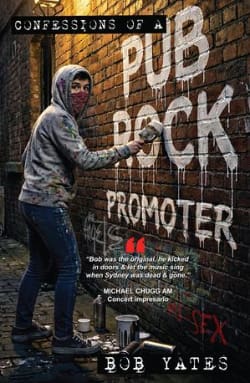
 Confessions of a Pub Rock Promoter
By Bob Yates
Peach Tree Press
Not every half-baked musician, rock manager, pseudo academic or person who has dipped their toe into the entertainment industry can write a music book. The output often makes good doorstops. Music writing is an art of its own. Not everyone can write a song, either, but that’s another story.
That said, we do have some great writers in this country with an ability to capture a vibe. The best have a vibrancy to their work and an ability to translate exciting moments.
Some memoirs make an emotional connection or show a deep understanding of a moment in time. Overseas, Suzi Rotolo’s book on the early NY folk scene and her relationship with Bob Dylan springs to mind. Locally, the darkly cynical work of Bob Short and his musical journey, or Jim Moginie’s autobiography, are examples.
When an author is able to combine all of the above, you have gold.
Bob Yates manages this, both with his candid story of his deep love and regret about the loss of his dutiful and talented partner Virginia, and his journeys through the Australian music industry.
The book opens with a vista of the the beige world of Australia in the 1950s and ‘60s. A world of Menzies, portraits of Queen Elizabeth, and blokes who wore long socks and shorts. Like many kids, Bob’s world changed suddenly with the arrival of The Beatles, the Rolling Stones and Dylan and then war in Vietnam.
Bob and Virginia were a young couple building a home and a life together. Bob’s story about the loss of his marriage while deeply involved in music carries a sense of regret and ultimately humility.
Sydney kid Bob Yates had already proven to have that entrepreneurial spirit; the local paper boy who mowed lawns for a few shillings with his sleeves rolled up. In his teens, he was playing the stock market and made heaps of money - enough to pay half the deposit for house in Balmain. He then lost a small fortune and was in heavily in debt.
The character of a hard-edged promoter was shaped at early age, along with an ability to climb out of a hole. Bob was back waking up at 5am to start work again, putting in enormous hours in factory work, mowing lawns or as a cleaner.
Yates fell into the world of booking, and promoting gigs from his early 20s. It was completely street level, handing out flyers, doing poster runs and hiring halls. He held packed events at Balmain and Paddington Town Halls, as well as in assorted community and church halls, and some of his gigs drew almost a thousand people.
Bob’s book provides insights of a scene that I knew little about. In the late ‘60s and early ‘70s, Balmain was a hub of Sydney culture. “Confessions of a Rock Promoter” shines a light on acts like Jeannie Lewis and Captain Matchbox as well as the lesser known ones - including Ward and Johnston, the duothat Bob managed, That he ended getting major international supports for them like Ike and Tina Turner provides an understanding of the wheeling and dealing involved. Bob Yates was certainly a mover and shaker for close to a decade.
It was towards the end 1976 that Bob sensed a change in Australia. The impact of Radio Birdman on Sydney has been well documented. It was not only the music. Doors were now open to a variety of new music and new venues were springing up – especially iun their home town Sydney.
The legendary underground spot, French’s Tavern on Oxford Street, was changing its booking policy and opening a rock room downstairs. A band with a fervent following on the city’s northside had recently changed its name from FARM to Midnight Oil, and was dropping its prog rock pretentions with a nod to Radio Birdman’s twin guitar attack. Birdman’s impact was equally evident on The Angels who were evolving out of being a roots boogie band from Adelaide into something more theatrical and calculated.
Bob Yates’ story of Midnight Oil auditioning for the Stage Door Tavern where he was now the booker is hilarious – especially with the arrival of the fast talking and intense Garry Morris as their manager. Bob booked the Civic Hotel in Goulburn Street and by 1978 it was a bastion of a new breed of bands, hosting the art students from Mental as Anything and early gigs by The Angels and Cold Chisel.
It was here that the early postpunk scene emerged into the light and it was full houses most nights. You can feel the energy of that time in Bob’s writing. Rooms like The Civic gave a home to arty indie bands and allowed them to be creative. Punk venues were also opening in the rundown parts of the city near Central Station and were drawing mostly underage kids. It was, as Yates relates, a real changing of the guard.
The book explodes as Ian Rilen makes his entry into its pages. Bob Yates perfectly captures the man’s spirit and charisma – the wildness and raw talent.
Ian’s formation of X had really made an impact on Sydney. A tough, street level bass player with a grounding in bands like Fraternity, Band of Light and the early Rose Tattoo, Ian left that latter band with “Bad Boy for Love” before departing because he thought they were heading in the wrong direction. Now he had a new beast.
Unlike Midnight Oil, who were allocated a Tuesday audition, Bob gave X their first Civic gig on a Friday night on reputation alone - and for a huge guarantee. The line-up down Pitt Street was full of a new breed of inner-city audience with a red “X” painted or stencilled onto ripped jeans and tee-shirts. X drew a full house, leaving scars on the carpet and broken glasses as far as the eye could see. Yet they were welcome back as they broke the bar record.
A couple of years later, Ian wanted Bob to manage his stunning new band Sardine V. Yates, had a fair a bit to do with Ian securing a publishing deal. Ian was certainly one of the most talented songwriters to have emerged on the scene.
Bob’s description of the inner-city music scene of punk and post punk is raw and exciting. Yates was well over a decade older than most of the musicians on stage and even older than an audience mostly aged in their teens. His background was a decade in folk music and roots bands. He describes the sudden shift as a massive tidal wave with words conveying the rawness and passion of the music itself. These bands he cites are names many of us know; Laughing Clowns, Lipstick Killers, Hitman, Ward 13, The Passengers, Jimmy and Boys, Flowers and The Professors among them, just to name a few.
Bob was now booker and promoter of The Civic, Stage Door and the Royal Antler on the Northern Beaches that was the Oils were packing out. A pivotal point for Bob was the arrival in 1978 of Mi-Sex from New Zealand, following a well-worn path trod by Dragon and the La De Das. Suddenly, they were the new band to check out. Yates was impressed.
A large section of book is focused on him taking them from a midweek, $50 a gig support band to being the biggest pop drawcard in Australia. It is tale of a gigantic rise to the top, built on belief, bravado and bold, sharp managements skills by a man who became workaholic. Sweeping up all the awards of 1980 and dealing with the American arm of CBS Records, the small-time Sydney promoter of a few years earlier found himself working with the biggest names in the industry and walking into the boardroom of a record monolith in New York City.
These are heartbreaking aspects to this. CBS were dickheads and it’s a body-blow to Bob when they don’t keep their word. There is a lot of fast talking. And the next thing can be another conversation and another line of coke. It’s a fascinating story and a warning to those who romanticised the industry without saying what really goes down.
Sadly, in world of inflated egos is a lack of understanding that what goes up can fall very quickly. Bob realises this is not his world and decides he wants out. He seen enough of where he does not want to be.
Bob’s final major foray into the big time was a Tiny Tim show, presented with artist Martin Sharpe at The Sydney Opera House. It’s a tale set in the twilight zone where art and street level promotion were never meant to meet.
Here we are in 2026 and the industry is completely changed and has lost its sense of alternative, counterculture. Private colleges have diplomas in music management and it’s a world away from the tough side of dealing with underworld figures with pistols in backroom offices drawers, bundles of cash in car boots, and amphetamine-fuelled roadies driving 3000 kilometres to get a band’s gear to a gig on time. A world with no Instagram, Facebook or band websites.
“Confessions of a Pub Rock Promoter” is a rip-roaring read by a gifted writer and a window into a time many decades ago.