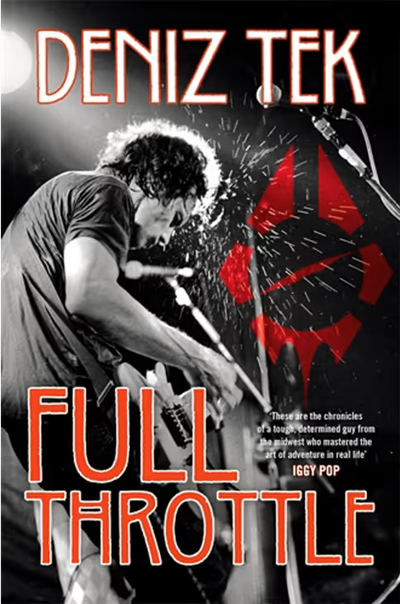
 Full Throttle
By Deniz Tek
Picador-Pan Macmillan Australia
Deniz Tek’s autobiographical “Full Throttle” hits the bookshelves at a time when “Retaliate First”, the newest and most detailed story of his most storied band, Radio Birdman, hasn’t yet made it to the remainder bins at Big W. It joins photographer George Munoz’s lavish coffee table effort, “When The Birdmen Flew”, and Chris Masuak’s “Faith and Practice in Bedlam” which are still available in stores.
Vivien Johnston's thesis in a biography's dust jacket, "Radio Birdman", was long regarded as the defintive history but is years out-of-print and fetches big bucks on eBay. And while Your ABC still won’t screen “Descent Into The Maelstrom” - still the best rock documentary made in this country despite being disowned by two former band members - it can be streamed on Apple TV or Prime.
So it’s a crowded dancefloor on which to do The Moving Change.
Tek has taken a different tack to most of those that have gone before. Rather than fixate on Birdman, “Full Throttle” tracks through its author’s time in military aviation and emergency medicine and casts a light on his solo bands and side projects. Appearances by the Birdmen are pre-flight or involve the final line-up and are fleeting. There’s no aggro and any contestable turf or uncomfortable issues are avoided.
The first review of this book to appear online had an issue with "Full Throttle" lacking a coherent narrative. That critque was written by a Nick Cave fan who once described bands that sprang up in Birdman's wake as "oafish".
On balance it probably does help if you know the Radio Birdman back story, but there’s enough meat on this book’s bones to maintain a casual fan's interest. The comment that there isn't enough self-reflection might carry weight, but there's also some surprisingly generous commentary about a former guitar partner who was integral to the Tek comeback album, "Take It To The Vertical".
At times, the telling of these tales does comes across as clinical. While it's true that there are no blinding revelations, no fresh insights and minimal humour, none of that should surprise. Most of the time, Tek tells us what happened and not enough about what he felt.
The breadth of “Full Throttle” seems an obvious strategy to reach a broader market. A means to an end from someone who says he . Parts will be familiar to many if not most people reading this. How many times can you re-tell the same Radio Birdman stories? It’s a rhetorical question that a prospective publisher would have asked.
Twenty-something years ago, I worked with Tek to lightly edit four sample chapters that he’d penned. Sydney graphic artist Murray Bennett created some mocked up pages using images that hadn’t made it into Johnson’s book. The concept was a coffee table book, light on word count but full of impactful images. The idea that such a book needed a narrative did not loom large because the band's mystique was still in place .
Radio Birdman still existed outside the industry mainstream and a literary pitch on behalf of a band member seemed like promoting a visit by an alien from another planet. Even the band’s subsequent entry into the ARIA Hall of Fame wouldn’t have granted admission to the Published Authors' Club back then.
The book was pitched to a good two-dozen targets. Most didn’t bother answering. One snob from a big-name publishing house wrote back, saying: “I didn’t know Radio Birdman fans could read.” Well fuck you too, buddy. To my eternal shame, I spilt coffee over his snide rejection letter and lost it before I had the commonsense to frame it and send it straight to the pool room.
A couple of those sample chapters are recognisable in the published version although the hand of an editor is apparent in smoothing the copy and making it flow. Tek’s clipped, economical language is intact - like guitar choppy riffs. It’s easy to read and if you stumble over the terms for various medical procedures or have no idea about an A4 or an F-14, the terminology is translated.
The insights into Tek's brief spell guesting with DKT-MC5 throw a spotlight on the tensions that few people outside the band’s inner circle knew about. I clearly recall those Sydney shows and how Rob Younger aced it on two songs at the Gaelic Club, and Tek’s playing being a red-hot poker up Brother Wayne’s arse as they swapped licks at Selina's. It’s also clear that reviving New Race with Wayne Kramer for a European tour was an idea that was never going to fly.
The road tales with Tek’s US band The Last Of The Bad Men (aka the mercurial skate twins Art and Steve Godoy) will be enlightening for anyone under the misapprehension that it’s a glamorous life.
In other highliughts, if you’d been an honorary Stooge for a handful of songs at a tribute gig in honour of Ron Asheton, you’d write about it too. None other than Jim Osterberg has endorsed the book. The concept of bean counters being allowed to run the NSW health system in the mid-2000s is exposed for the crock that it still is and is presented as the straw that broke the back of Tek’s Accident & Emergency career.
 1/3
1/3
Disclosure: The reviewer manages former Radio Birdman member Chris Masuak.
2/3