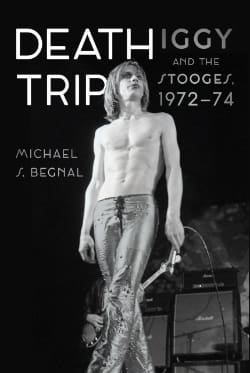
 Death Trip. Iggy and The Stooges 1972-74
By Michael S. Bengal
Reaktion Books
This hefty 328-page opus tracks the rise and plummet of Iggy and The Stooges in their “Raw Power” era in precise form. You should consider its existence a significant act of community service.
There’s no shortage of detail in Michael S. Bengal’s dissection of this critical period in the three chapters of The Stooges Story. Calling it exhaustive does not do it justice. Saying it tells you who recorded what and when doesn’t go far enough. Through contemporaneous media reports, published recollections and clear-headed investigation, “Death Trip” establishes rehearsal dates, likely set lists, and summarises critical reaction.
New interviews with guitar weapon James Williamson, mid-period/New Order bassist Jimmy Recca and pianist Scott Thurston add to the world’s body of knowledge. The amount of work put in is awe-inspiring. The cited references and sources run to 49 pages.
The author has identified the period leading up to and following the recording of the seminal “Raw Power” as the richest vein to mine in the Stooges story. It’s the second act of three that has enough high drama, triumph, tragedy, interpersonal ups and downs, existenital angst and corporate manipulation to fill any screenplay.
Here’s where things become complicated. Bengal’s hypothesis is simple but the writing of his thesis is not. He (correctly) says the eight tracks on “Raw Power” draw on the roots of '50s rock and roll and lay down a baseline for so much that has followed since the record's muted reception in 1973. He debates positions and perspectives – at length. He dissects each songs - right down to their chord changes. Details matter but at times, the scholarly analysis gets in the way.
Oh yes, this Death Trip has sex and drugs in spade-loads, but Bengal doesn’t dwell on them. “Please Kill Me” it is not. Drugs were inarguably one cause of the band’s demise but were also a reaction against the band’s handling. The resistance to the band and its music from an incredulous management and a short-sighted record company were the bigger issues - and there was that broader environment of public indifference.
The author again correctly points out that building an audience through the power of their live shows alone was never going to sustain Iggy and the Stooges over the long haul. Alice Cooper had a theatrical stage show but also prospered on the back of a breakthrough album.
The biggest problem with a scholarly approach is that the colour is drained from various vignettes by the manner of their telling. It was obvious quite early in its reading that “Death Trip” needed a heavier edit. It was heavy going. If you want colour and movement, Paul Trynka’s “Open Up And Bleed” remains the benchmark that you won’t be able to put down. You could do worse than have both books close at hand for cross-referencing.
But if you’re a Stooges tragic and this deters you from reading it, think again. I come to praise “Death Trip” not to bury it. As mentioned earlier, it’s a valuable addition to the canon. The author’s analysis of the lyrics resonates in most cases. Which mix of the album surfaced in pre-release acetate form or the short-run UK pressing is now clear. I needed to know what Iggy and the Stooges played at Kings Cross Cinema in London in 1972.
Diving down a post-Stooges rabbit hole, did you know that New Order’s “Rock and Roll Soldiers” and Patti Smith’s “Summer Cannibals” both derived their backbone riff from the song (also "Summer Cannibals") played by Sonic Smith’s post-MC5 band Ascension in 1973, of which Dennis Thompson was a member? Gotta check that factoid via my live bootleg collection.
Anyway, the case rests and, on balance, Detective Inspector Bengal has done justice to the circumstances and legacy of "Raw Power". And if you're a Stooges tragic, that's what counts.