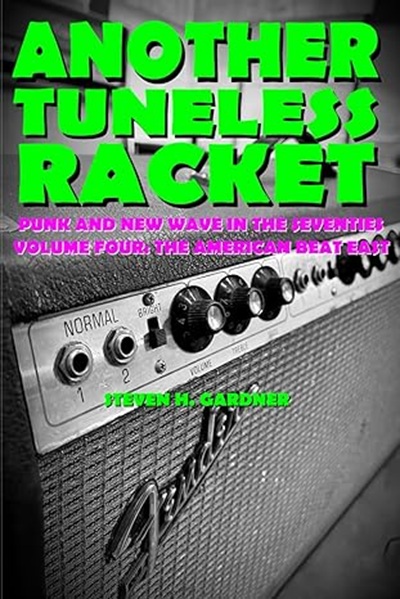
 All Another Tuneless Racket. Punk and New Wave In the Seventies Volume Four: The American Beat East
By Stven M Gardner
(Noise For Heroes)
The intention was to read this cover-to-cover before penning a review, but time got the upper hand. As it does. You need to know about it before the onset of the Festive Season proper so you can put it on your Xmas shopping/wish list.
I’ve been dipping into and out of this “Another Tuneless Racket 4” over the past three months. It’s a punk rock “War and Peace” at nearly 690 pages but not a hard slog. It’s neatly compartmented into various regional musical scenes, so “ATR Volume Four” is ideal fodder, if your attention span is short or you want to dip in and out.
Notwithstanding it weighs a lot more than a mobile phone, you might find it essential Toilet Reading (or “Bathroom Reading” for sensitive Americans who think a bathing facility is co-located with what we Australians call The Dunny.)
Reading on the loo is probably a Bloke Thing but certainly not exclusively the domain of men or Australians. The bog is one place most people know they won’t be disturbed.
There’s a bonus if you’re getting on a bit and are not, er, as regular as you used to be, in that you can spend a long time combing these pages. The hefty size of “ATR4” (it’s nearly as heavy as one of those extinct things called phone books) means that if you lift your copy past shouilder height a few times, you can skip the gym.
There’s a lot to be said for Toilet Books. A good one takes your mind off the government bowel testing kit that arrived in the mail and is sitting on your sink, unopened. If you’re a Westerner visiting Japan, reading is less taxing than working out what all those controls on the side of the cistern do.
Unlike Jinglish instructions or medical self-diagnostics, however, “ATR” is a labour of love that comes from Steve Gardcner, the same rock and roll obsessive who spawned the American zine “Noise For Heroes” in the 1990s, and the record label of the same name.
It’s delivered in the author’s own idiosyncratic style. Which is to say Steve combines a laconic, dry humour with an exhaustive attention to detail. He’s combed media reportage at the time with his own writings for these analyses of regional scenes, but just because it’s well referenced doesn’t mean it’s an academic exercise. Unlike a few writers I won’t name, Steve has actually listened to the music.
Volume Four covers the New York, Detroit, Ohio, Boston and Midwest scenes and takes side trips into the Deep South and Upstate NY areas.
New York City takes 200 pages but if you’re looking for exhaustive coverage of the usual suspects like Ramones, Television, Talking Heads and Blondie, you’re fresh out of luck. Any significant NYC band with a record out in 1978 or prior was covered in Volume One. “ATR4” goes past CBGB and Max’s and digs deep into the other crevices, telling tales about Chris Stamey, dBs, Jane County, The Cramps, Marbles, Wille Alexander et al. Much of that scene (and the others) are viewed in the context of the role that media played in shaping and reporting on it.
Steve’s no subscriber to the linear theory of American Rock and Roll in which the Stooges and the MC5 begat the New York Dolls who birthed the Ramones, who became Johnny Appleseeds and spawned countless offspring without breaking in their own right. Any student of communication theory will know that he’s correct and even if he’s not, it’s his book.
Naturally, one of my first “ATR4” dives was into the Detroit chapter and it was satisfying to see the author reject one local scenester assessment of Sonic’s Rendezvous Band being what the bitchy UK music mags would have called “Rockist” and Destroy All Monsters getting their dues. It was equally satisfying to dig into the detail about lesser lights like Cinecyde (who lay claim to the area’s first punk record), The Ramjets, The Sillies and The Mutants.
The assessments of various scenes generally have ample commentary and enough detail to become compulsive reading. Steve’s eye for detail does hand-in-hand with his sense of curiosity, so a dive into the Boston scene becomes more than just some recycled tripe about The Real Kids and Jonathan Richman. You may not need to know the names of 50 bands of note who played The Rat, but it won’t be you any harm at the next pub trivia night either.
The good news is that the information nuggets the entire “ATR” series imparts are almost always backed up by aural evidence (primarily, whatever recordings exist.) The only big fault I can find is the lack of an alphabetical index at the back to help locate various bands without trying too hard (although it’s easy enough to look back at the relevant chapter to scan for a bolded name.)